Where money and valuable assets change hands online, scammers follow. Domain owners receive fake offers, fake renewal notices and fake escrow links every week. The good news: almost every scam relies on one of a handful of tricks. Learn to recognise them and you are already safe from most of them.
Key takeaways
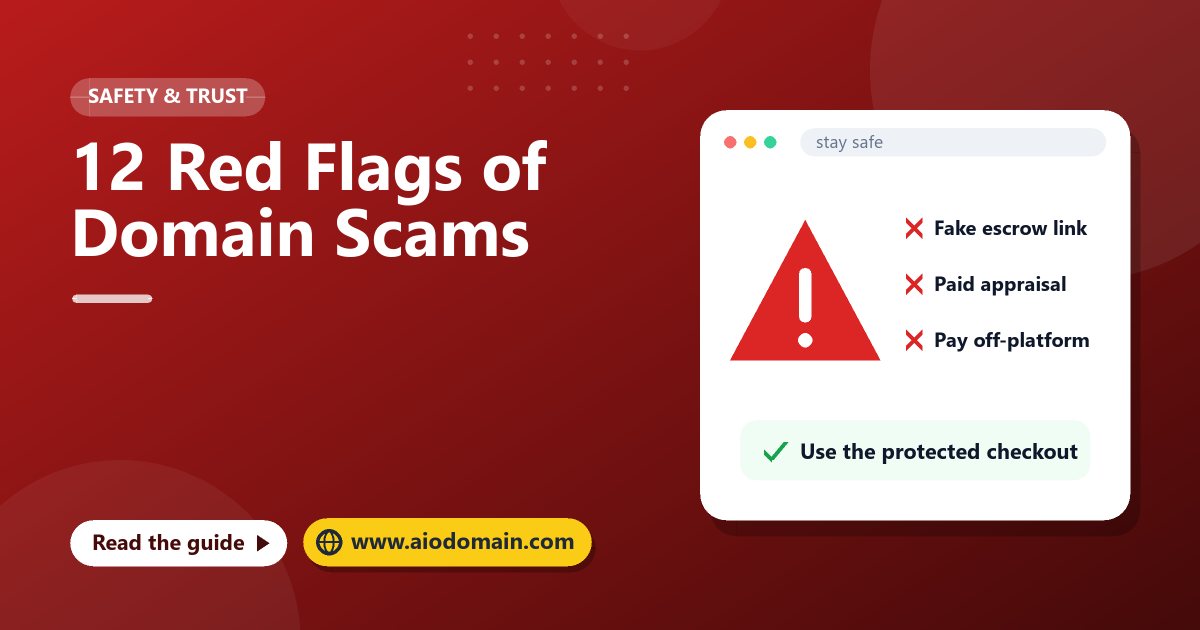
- Never pay or transfer outside a protected marketplace checkout or licensed escrow.
- Never use an escrow or payment link sent by the other party.
- Real buyers do not ask you to pay for an appraisal first.
- Protect registrar and e-mail accounts with two-factor authentication.
Scams that target sellers
1. The appraisal trick
A "buyer" makes an exciting offer but insists you first get a paid appraisal from one specific site. The appraisal site belongs to the scammer, and the buyer disappears after you pay. Legitimate buyers decide their own price.
2. Fake escrow
The buyer pushes a professional-looking escrow site you do not know. You see a "payment received" message and transfer the domain, but no money ever existed. Read how real escrow works.
3. Overpayment and refund
The buyer "accidentally" pays too much and asks you to refund the difference. The original payment is later reversed.
4. Pressure to transfer first
"I have sent the money, please transfer now, my boss is waiting." Urgency is a classic sign. Wait until the platform confirms the payment.
Scams that target buyers
5. Sellers who do not own the domain
Anyone can claim to own a name. Prefer listings with a Verified badge, which means the seller proved control with a DNS record that is re-checked regularly.
6. Requests for unusual payment methods
Gift cards, crypto to a private wallet or a wire to a personal account cannot be reversed. A marketplace checkout can hold or refund your money.
7. Too-good-to-be-true prices
A premium name at a fraction of its value is usually bait. Check the seller's history and reviews.
8. Moving the conversation off the platform
Scammers want to leave the marketplace, where messages and payments are recorded. Keep everything on the platform.
Scams that target every domain owner
9. Fake renewal and "domain expiry" notices
Letters and e-mails that look like invoices try to get you to renew, or transfer, through an unknown company at inflated prices. Renew only through your own registrar account.
10. Phishing for registrar logins
An e-mail says your domain will be suspended and links to a fake login page. Always type your registrar's address yourself.
11. Search engine "submission" offers
Messages offering to register your new domain with search engines for a fee. Search engines do not charge for this.
12. Hijacked e-mail and accounts
If attackers control your e-mail, they can reset your registrar password and move your domains. Use unique passwords, two-factor authentication and a registrar lock.
Your safety checklist
| Do | Do not |
|---|---|
| Use the marketplace checkout or licensed escrow | Pay a stranger directly |
| Buy verified listings | Trust a screenshot as proof of ownership |
| Keep messages on the platform | Move to private chat apps |
| Turn on two-factor authentication | Reuse passwords |
| Report suspicious users | Ignore your instincts |
If you think you have been targeted
Stop all payments and transfers, change your registrar and e-mail passwords, turn on two-factor authentication and contact support. On AIODomain, use the Report link on a listing or profile, or contact us. Our buyer protection rules explain what we can do.
Frequently asked questions
Is an unsolicited offer for my domain always a scam?
No, genuine buyers do reach out. The red flags are requests for upfront fees, specific appraisal or escrow sites, and pressure to act fast.
Can a stolen domain be recovered?
Sometimes, through the registrar and the registry, especially if you act quickly. Prevention through account security is far easier.